So how long do I wait to call? Gen Z vs. millennial brand builders in UK & US DTC
Swingers: A movie that launched two megastars with its own vernacular too. Proof that generational differences are not exclusively for us.
Trent: I wish they still had fights in this game so I could bitch-slap Wayne.
The V Spot eCommerce Nearly News is a reader-supported publication. To receive new posts and support my work, consider becoming a free or paid subscriber.
Mike: What? They don't have fighting anymore?
Trent: Doesn't that suck?
Mike: Why'd they get rid of the fighting? It was the best part of the old version.
Sue: I think kids were hittin' each other or somethin', man.
Trent: Yeah but you know what, Mike? You can make their heads bleed in this one.
Mike: Make somebody's head bleed.
Sue: No man, we're in the playoffs.
Sue/Mike/Trent, Swingers (1996)
Something has bothered me for some time and I wanted to try piece this together about 6 months ago. I started and then I stopped. US conferences are littered with people my age and older. UK I am the old guy. The stories are being delivered by completely different people. It’s not just an age or culture thing. It is to do with how companies are owned and structured. Dig a little deeper off the conference circuit and you will find them. Maybe.
For a solid decade, building a DTC brand felt like the ecommerce equivalent of counting cards. You needed cheap capital, a Shopify store, and a decent founder origin story. Thanks to the ZIRP years (Zero Interest Rate Policy, 2008–2021), capital was effectively free, VC firms were swimming in dry powder, and the barrier to entry was low — but the ceiling was sky high - said Icarus.
Between 2014 and 2021, over 85 DTC brands achieved unicorn status globally (Oh how I dreamt of it - fact check, I actually dreamt of this last Thursday. Spawning the need to continue the article - sad bat*ard) — many with Millennial founders at the helm. US and UK names like Glossier, Casper, Away, Allbirds, BrewDog (I am an unofficial shareholder - drink consumptionO , Made.com, and Gymshark all raised at high multiples on the back of direct-to-consumer hype, investor FOMO, and CAC-fueled growth.
But here’s the kicker: most of them underperformed post-2021.
Casper went public in 2020, then was taken private for a fraction of its IPO value.
Made.com collapsed into administration in 2022.
Allbirds stock is down over 95% from IPO peak.
Glossier laid off staff and pivoted to wholesale with Sephora.
In hindsight, many of these brands weren’t built to last — they were built to scale. Growth was the KPI. Profit was optional. It worked while interest rates were near zero and Facebook ROAS was still above water.Today it is still above water, just, and is still a barometer of survival for many.
Then the music stopped.You and me and a bottle make three tonight.
Enter Gen Z — a generation raised in the ashes of Millennial ecommerce ambition, hardened by recessions, algorithms, and economic chaos. Their playbook doesn’t start with a seed round. It starts with a phone, an idea, and a comment section. The phone, arguably if the iPhone were not invented, I would not be writing this.
I wante to explore for some time how Gen Z brand builders are approaching the game differently — and what legacy, if any, Millennial DTC culture has left behind.
Because in 2025, it’s not about whether you’re “so money.” It’s whether you know how to turn attention into margin. “What do I do with these fangs? How do I kill the bunny?”
While Millennial DTCs rode the wave of cheap money and predictable media buying, the post-2019 era has looked radically different. Gen Z-founded or Gen Z-aligned brands emerged in a world where:
Paid media no longer guaranteed predictable growth. It did once upon a time.
Consumers demanded transparency, ethics, and entertainment
And funding came with strings, dilution, or… just didn’t come at all. This is an almost daily cautionary tale in the news.
But here's a twist: they’re growing anyway — and sometimes, faster.
Since 2019, a new cohort of DTC challengers has gained traction not by outspending competitors, but by out-creating and out-connecting with their audiences.
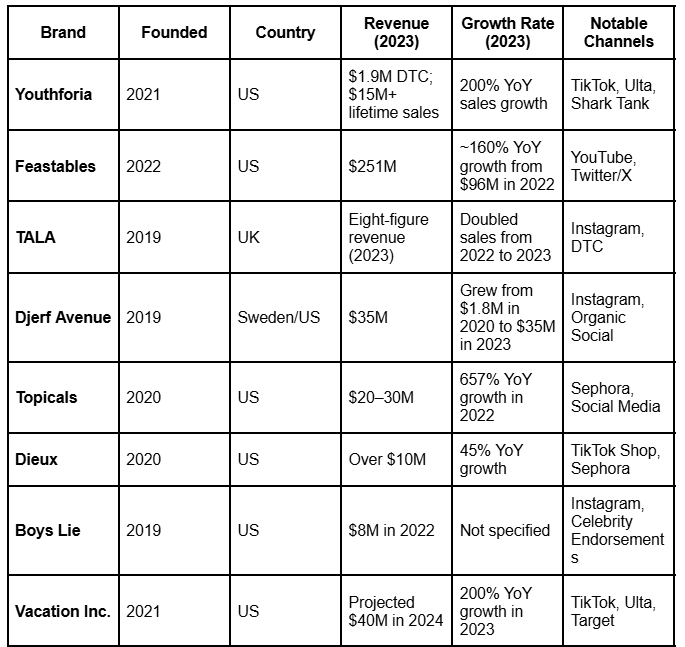
Notable post-2019 Gen Z-era DTC brands:
Many of these brands were bootstrapped or launched with micro-funding, and grew through creator partnerships, community-building, and channel-native storytelling. They seem to know where there audiences are because the are their own consumer first. Not square pegged into a round hole.
Unlike the ZIRP-era unicorns, they don’t need $50 million to break through — they need a viral moment, a smart creator collab, and a shipping partner that can handle scale.
What’s more? These brands often report profitability within 12–24 months, not because they’re cautious, but because they’re building for cash flow, not burn rate. This is something I learned alot about recently - - It didn’t occur to me for sometime.
There is a fluency around the speech of cash flow in this world that is not spoken about.
So if the Millennial era of DTC was about scale, sleekness, and Series B...The Gen Z era is about scrappiness, story, and soul.
These brands aren’t just selling smells, sunscreen, sweats, or serums — they’re building identities. Movements. Micro-tribes. In fact, if Millennial DTC was a business plan with a vibe layered on top, Gen Z DTC is a vibe with a business model wrapped around it.
Note: Gymsahrk Head of Brand Noel Mack articulates their COVID story so well. Careful social listening meant their community thrived and expanded during COVID. It gave them licence to appear elsewhere and move from Gym Floors to Front Rooms and then into Yoga Studios - now they boast stores in London and New York.
Djerf Avenue. It doesn’t run ads. It barely uses traditional influencers. Yet it has built one of the most loyal, global customer bases in fashion — Every post, drop, and caption is in her voice. The comments section reads like a group chat. The fans don’t just wear the clothes — they evangelize the ethos.
Or look at Topicals, the skincare brand founded by Olamide Olowe. Topicals isn’t selling you perfect skin — it’s selling you self-acceptance, community care, and science-backed honesty. The brand’s most viral campaigns have come not from influencers, but from raw, heartfelt stories shared by its own customers. Many try to repeat this formula, many fail.
And Youthforia, built on the idea that makeup should be safe enough to sleep in, built its early community on TikTok not with polished UGC, but by showing founder Fiona Co Chan experimenting with formulations, answering DMs, and turning skincare routines into storytelling formats.
So here’s my question:
Do Gen Z founders simply understand social media — and by extension, modern culture — in a more instinctive, authentic way than their Millennial predecessors?
The evidence suggests yes. Not always in structured case studies, but in the thousands of micro-interactions that happen daily:
Founders replying to DMs directly
TikToks made on the fly that outperform six-figure campaign shoots
Discords, BeReals, Close Friends stories — not for press, but for proximity
Product lines and drops co-created in comment sections, not market research decks
What used to be called "community" is now embedded into the product, the packaging, the pitch decks. And in this world, community isn’t something you build — it’s something you belong to.
It’s not that Millennials didn’t try to do this..
They live in the algorithm. They are the algorithm.
Hang On Voltaire
And yet, not all Millennial-led brands followed the same script of heavy paid ads, cool packaging, and eventual burnout. Some — like Fanatics — quietly built something far more resilient: an ecosystem. (Oft repeated, rarely replicated).
Founded by Michael Rubin, a Millennial entrepreneur with a long history in commerce, Fanatics didn’t chase DTC hype. Instead, it built a digital empire by embedding itself directly into the infrastructure of sports fandomnot just through merchandise, but through partnerships, licensing, and platform control.
In many ways, Fanatics is the ultimate Millennial-led platform play:
It owns the rights to produce and distribute official merchandise for leagues like the NFL, NBA, and Premier League.
It partners with media companies, sportsbooks, and even NFT platforms.
It’s vertically integrated to the point that Fanatics can design, manufacture, sell, and ship product — often within hours of a major game or viral moment.
It’s relentlessly fan-first.
From limited edition drops timed to real-world sports events to customization that puts the buyer in control, Fanatics operates like a SaaS company that happens to sell jerseys. The data loop is tight. The brand loyalty is tribal. And the experience is built not just for the moment of purchase but for a lifetime of fandom.
Fanatics shows us that Millennial brands — when built with infrastructure, partnerships, and purpose — can scale culture in a different but equally powerful way.
Fanatics isn’t trying to be relatable. It’s trying to be inevitable.
Now to look at what has happened and what is happening. A potted reflection.
Platforms, Tech & Channels
“This place is dead anyway.” – Trent
The first sign of a generational shift? What they build on — and more importantly, what they don’t.
Millennials built DTC empires with Shopify, Klaviyo, and Facebook Ads. It was a predictable stack: plug, play, scale. Agencies were hired, LTVs were calculated, and growth loops were baked in with surgical precision. It was chess.
But Gen Z is playing Fortnite. They’re skipping full tech stacks in favor of social-first, scrappy, and wildly dynamic go-to-market moves. To them, Shopify is optional. Virality is not. And when Shopify does enter the picture, it’s often after they’ve already proven traction via TikTok Shop, live drops, or Discord pre-orders. (It is not all healthy or a world I want, but)
US Examples:
Glossier had a blog, a waitlist, and VC money.
Finesse uses AI to decide what to design next — flipping the product pipeline upside down.
UK Examples:
TALA launched on third-party systems before replatforming at scale — now a Shopify Plus brand, but only once the foundations were proven. (Grace Beverley, Founder spoke at eComm Live in Belfast a month ago. She is an incredible proponent of this lifestyle). Lifestyle and smarts. WOW.
What’s going on here?
There’s a potential correlation that’s worth considering: Gen Z brands may be consciously or unconsciously delaying major tech investments to prioritize the right people, not just the right platform. People grow communities remember.
While Millennials often secured VC early and raced to build scalable infrastructure (internal ops, robust ecommerce stacks, 3PLs), Gen Z seems more inclined to:
Outsource ops early via scrappy tools or freelancers.
Focus in-house talent on brand, storytelling, and community.
Keep overhead light and decision-making nimble.
Instead of hiring a VP of Ops in month two, Gen Z founders are hiring a content editor or a community manager. Their first five hires might include a TikTok creator, a Discord mod (Yes, I have a Discord account), and someone who “just gets memes.” And weirdly, it works.
In the old DTC world, tech was the enabler. In the new one, tech is background noise — people and proximity are the differentiators.
If the Millennial ecommerce stack was a paint-by-numbers mural. Gen Z prefers graffiti — temporary, viral, and designed to get you talking. And maybe, by holding off on tech-heavy investments, they’re giving themselves the budgetary and creative space to build something more emotionally scalable: a real community.
Hiring & Team Culture
“You’re growin’, you’re learnin’, and I’m the one who’s gettin’ better.” – Mike
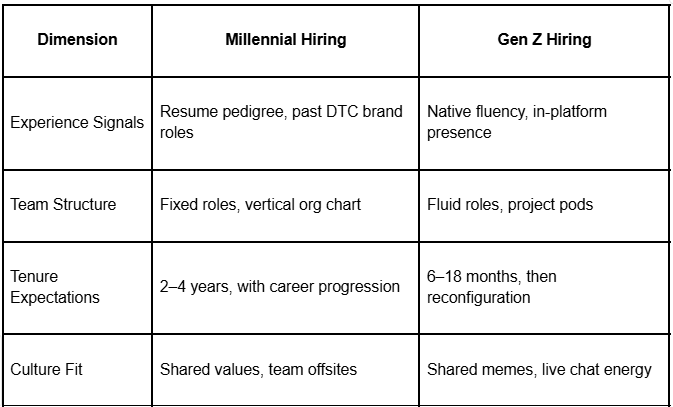
If at first is about what you build with, this phase is about who you build with — and how long they stick around. Leaving is not a bad sign. There seems to be role and brand fluidity. You learn at one place and someone else benefits. Contracts are changing, as are roles.
Millennials Built Teams to Scale
Millennial DTC brands followed a well-trodden hiring path:
Seed round → hire a Head of Growth
Series A → bring in a VP of Ops, a Head of Brand, and a Retention Lead
Series B → stack out the org chart like you’re building a LinkedIn B2B SaaS company
Tenure mattered. Roles were clearly defined. You wanted the person who’d “been at Warby” or “scaled something from $5M to $50M.” The same faces, from the same LinkedIn carousel, doing the same job at the next funded startup.
There was safety in pattern-matching — even when that pattern led to bloated orgs and internal turf wars by year three. Hoping I get picked up for something soon BTW - price for anyone noticing this.
Gen Z Hires In Platform, Not In Theory
Gen Z founders think about experience differently — and not just because they haven’t had time to build ten years of it themselves.
They want:
People who live inside the platform.
People who get the joke before it's explained.
People who can react in real time, not run a four-week sprint retrospective.
In this world, a 21-year-old TikTok mod with three years of content-native instinct may be more valuable than a 35-year-old CMO with a polished resume and a PowerPoint deck on Gen Z behavior.
Roles are fluid. Job descriptions are vibes. Titles might be “Head of Chaos,” “Moodboard Ops,” or “Community Wizard.” The structure is secondary to the energy. I know we shake our heads and say WTAF. (Why the face - Phil Dunphy).
Tenure? It’s Not the Point
It’s increasingly common in Gen Z-led teams to see people cycle in and out within 12–18 months. Not because of burnout or toxicity — but because the job evolves too fast for the org structure to keep up. Platforms, algos change - behaviors that change are more micro than macro - maybe my single biggest learning here.
Freelancers become co-founders. Creators become merch managers. A Discord community lead might disappear one day… and pop back up six months later with a whole new idea.
Gen Z leadership understands that team loyalty isn’t measured in years — it’s measured in impact velocity. The question isn’t “How long will you stay?” It’s “What can you help us do right now?”
Key Contrast: The Hiring Compass
If Millennial founders hired for predictability, Gen Z hires for presence. It’s not about your resume — it’s about your reaction time in the group chat. And in this new era, loyalty isn’t proven in performance reviews. It’s shown by dropping the right gif at the right time. With my GIF volume I think I am regressing - more on that later.
Always Double Down on 11: Funding
For Millennial DTC brands, venture capital wasn't just a funding option — it was the default OS. Between 2010 and 2020, the direct-to-consumer boom was fueled by a flood of VC and private equity money. Globally, DTC startups raised between $8 billion to $10 billion across more than 600 deals since the start of 2019 alone .
This capital influx was driven by the promise of rapid growth and the allure of disrupting traditional retail models. Brands like Glossier, Casper, and Allbirds became emblematic of this era, securing massive funding rounds to scale operations, invest in customer acquisition, and expand product lines.
Growth-at-all-costs mentality often led to unsustainable business practices. Many of these brands faced challenges in achieving profitability, with high customer acquisition costs and intense competition eroding margins. The pressure to deliver quick returns to investors sometimes resulted in strategic missteps and overexpansion. In many cases the model for growth adopted was the ones the money wanted to see. They thought they had it right. UK finance was more risk led and didn’t see the same path forward much to my own frustration with Crua. Valuations were smaller, equity requests higher and dilution was not just a popular Irish summer drink.
In contrast, Gen Z entrepreneurs are approaching funding with a different mindset. They prioritize sustainable growth, community engagement, and authentic brand storytelling over rapid scaling. Many are opting for alternative funding methods, such as crowdfunding, bootstrapping, or seeking smaller, strategic investments that align with their brand values.
This shift reflects a broader change in the entrepreneurial landscape, where success is measured not just by valuation or market share, but by the strength of the community built around a brand and its long-term impact.
“It’s not so much me as it is Roenick; he’s good.” – Mike (after losing at NHL '94)
Millennials were the VC darlings. Their brands were in pitch decks from Soho House to Silicon Valley. They raised big rounds, burned cash to acquire users, and aimed for acquisition or IPO. That strategy built unicorns and also some very public faceplants.How do we spend all this money?
Gen Z watched that play out and said, “Nah, we’re good.” Instead, they crowdfund, pre-sell, and bootstrap. If they take capital, it’s often from non-traditional sources — creator funds, community-driven DAOs, or low-dilution indie VCs.
Crowdfunding is something I have worked in for 8 years + and it speaks the same language as GEn Z. Kickstarter is all about community building, common purpose and belief in purpose over certainty. Seedrs, a testament to ingenuity and people wanting to belong. More on that in a retrospective.
Millennial Wins:
Bloom & Wild → Big PE backing (They really piss off my Irish client who is a competior)
Casper → IPO with major buzz
Outdoor Voices → Raised millions, built a vibe (until it imploded)
Gen Z Moves:
Djerf Avenue → Bootstrapped, insanely profitable
Feastables → Launched via MrBeast's content engine
Youthforia → Landed in Target without VC hype
For Millennials, capital was fuel. For Gen Z, it’s seasoning. A little goes a long way and too much ruins the dish.
It’s Scorcese, Everything is Derivative: Culture & Values
“I don’t want you to be the guy in the PG-13 movie everyone’s really hoping makes it.” – Trent
Culture isn’t what’s on the About page — it’s how the brand behaves when no one’s watching.
Millennials injected sustainability and inclusivity into their brands after the Series A. It was a move toward relevance, not always belief. Gen Z? They start with their identity. If the brand isn’t value-driven from day one, they won’t build it and consumers won’t trust it. That’s why Costner did so well. An early believer in himself.
Whether it’s mental health transparency, LGBTQ+ support, or anti-fast-fashion supply chains, Gen Z brands reflect who they are, not just what they sell. This will become even more impotant as DEI is being eroded on the high street. Brand values will be sought out and this is a place where Agentic commerce could find a way forward. Cater only to my beliefs, forget the rest.
Case in Point:
Gen Z brands shut down for mental health days — and post about it. I sometimes cringe seeing some of it. But just be around these people, they believe. It is hard not to feel inspired or silly in equal measure. Silly, for reference in that I am a generation removed.
Their "About Us" pages read like diary entries.Dog Days Diaries, i mean…
They actively dismantle DTC norms: size charts, return policies, even packaging.
If Millennials tried to look good on paper, Gen Z is more concerned with how they look crying on TikTok. Vulnerability isn’t a weakness it’s the content plan.
Category Winners & Losers
“This is a gorgeous baby. You’re money. You’re so money and you don’t even know it.” – Trent
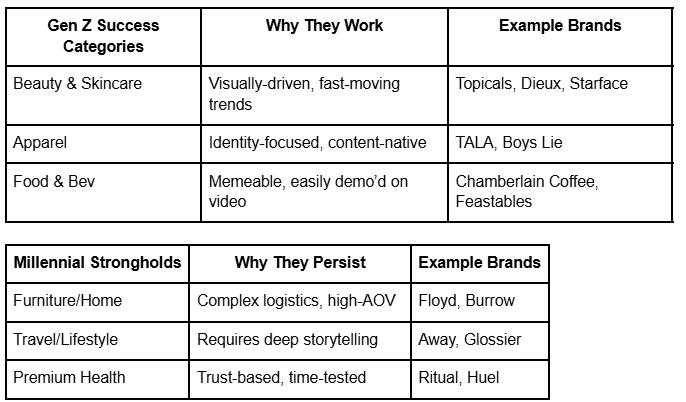
Some categories lend themselves to generational reinvention — others cling to the old guard.
Gen Z Success Categories
Gen Z owns the impulse buy. Millennials still rule the considered purchase. But watch closely even furniture might go viral in the right hands (hello, TikTok couches).
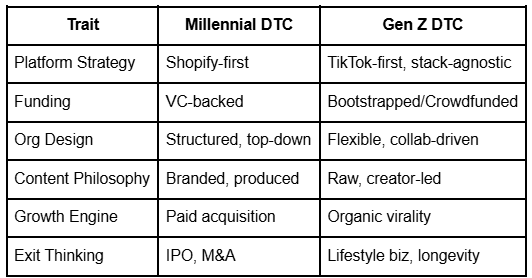
Hang on Voltaire: The Generational Face-Off
“I don’t want to be one of those ex-suit guys sitting in a coffee shop.” – Mike
I’ll be honest — classifying generations is messy business. Nobody wakes up and says, “I’m building like a textbook Millennial today,” or “Time to lead with full Gen Z energy.” Reality is blurrier than that. What you’ll read here isn’t carved in stone. It’s not a McKinsey quadrant. Thankfully. It’s a pattern — one I’ve noticed after years working with DTC founders, speaking at events, watching pitch decks roll in, and sharing drinks with both exhausted CMOs and hyper-energized 22-year-olds who can build a cult following in a weekend.
Some brands straddle generations. Some teams are run by a Millennial founder with a Gen Z brain trust. Some Gen Z brands will raise $50M and blow it. Some Millennial brands will pivot, downsize, and finally find sustainable profit in year seven. There are no hard and fast rules — only shifting energies, different tools, and evolving instincts.I like to think this is something to watch. Particularly as I find myself increasingly looking to get back into brand world. Where do I fit? I should be employable, but am I? Really?
Because whether you’re building your brand off vibes or venture debt, one thing’s certain: ecommerce is no longer a one-size-fits-all game. As I said before we operate in a multi tiered system.
Trait
This isn’t a passing of the torch — it’s a burning of the playbooks. Gen Z didn’t wait for permission to lead and they don’t ask for forgiveness. They just turned the camera on and started talking.
This my friends, is breakfast in the Age of Enlightenment.
IYKYK.
The V Spot eCommerce Nearly News is a reader-supported publication. To receive new posts and support my work, consider becoming a free or paid subscriber.